Proximity Blindness
in Hand Therapy
Proximity blindness is a multi-dimensional cognitive trap in hand and upper limb clinical reasoning, named and described by Ms Michelle Razo CHT, Consultant Hand Therapist.
Proximity blindness in Hand Therapy describes a cognitive trap in upper limb assessment and diagnosis. A clinician's attention can anchor on what is most apparent in a clinical presentation, missing what is actually driving it.
The term proximity blindness is established in cognitive psychology and attention research, where it describes how detection of unexpected stimuli falls off as a function of distance from the focus of attention. Ms Razo extends this idea to assessment of the hand, wrist, elbow and shoulder, naming and developing the application within her Hand Therapy practice plus teaching as a deliberate prompt to look beyond what first comes to mind.
Three dimensions in Hand Therapy
A chain of clinical traps
-
Diagnostic framing
What may seem like the most likely diagnosis is not always the underlying pathology.
-
Anatomical proximity
What could appear as a local problem may have its source elsewhere along the kinetic chain.
-
Concurrent conditions
What may present as a single condition can mask coexisting pathology.
In clinical practice
Where the traps catch us
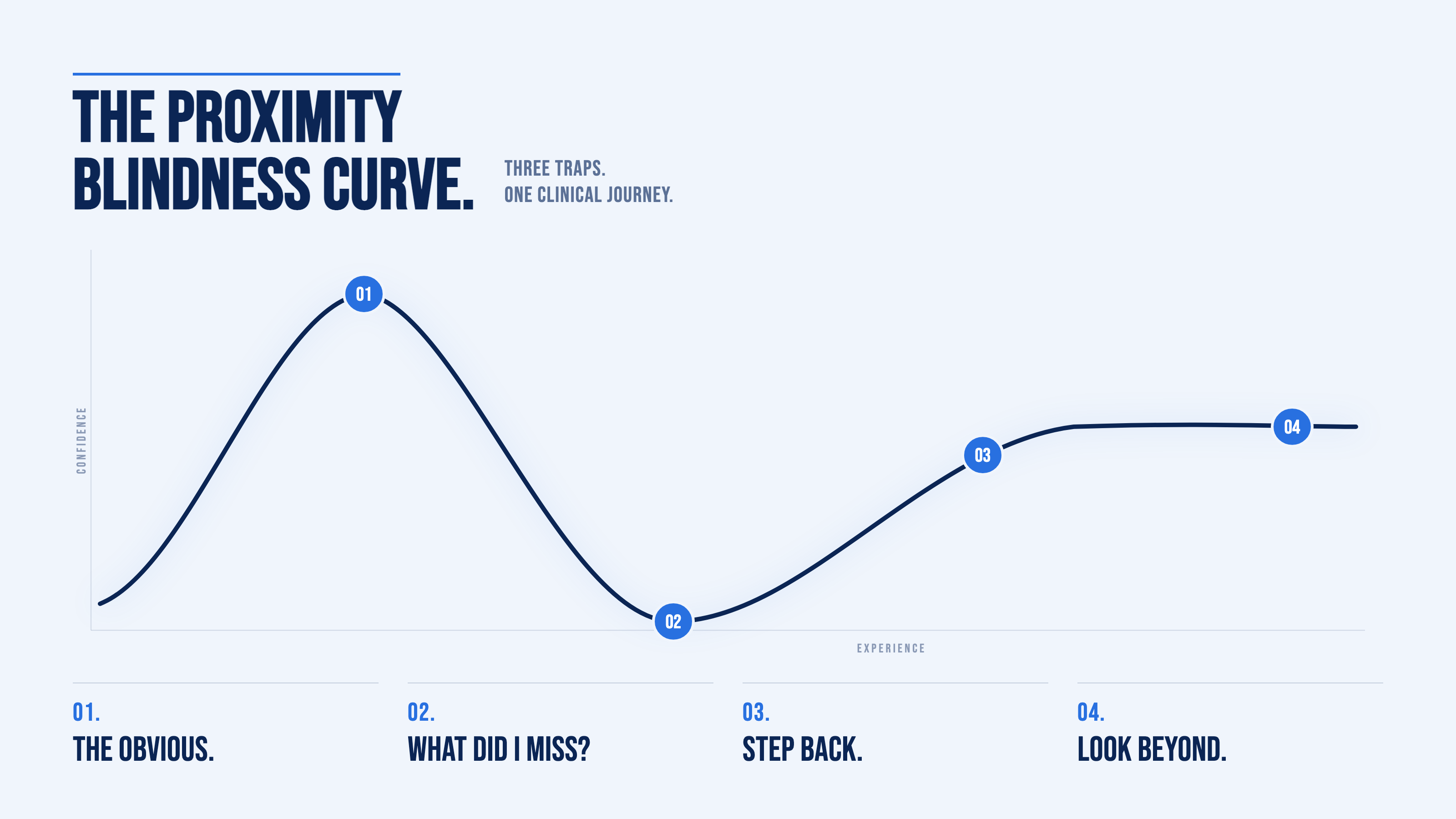
Ms Razo first publicly introduced the concept of Proximity Blindness in Hand Therapy with the presentation A Different Spin: Rethinking Golfer's Elbow at the 2025 International Hand & Wrist Congress and Hand Therapy Symposium in Dubai on 8 November 2025. Discussed again on the More Than Just A Hand podcast with Hand Therapist Blair on 4 May 2026.
Working with patients
who are not improving?
Specialist Hand Therapy assessment of the hand, wrist, elbow and shoulder can help where the obvious diagnosis, anatomy or presentation has not led to recovery. Refer a patient or get in touch to discuss a complex case.