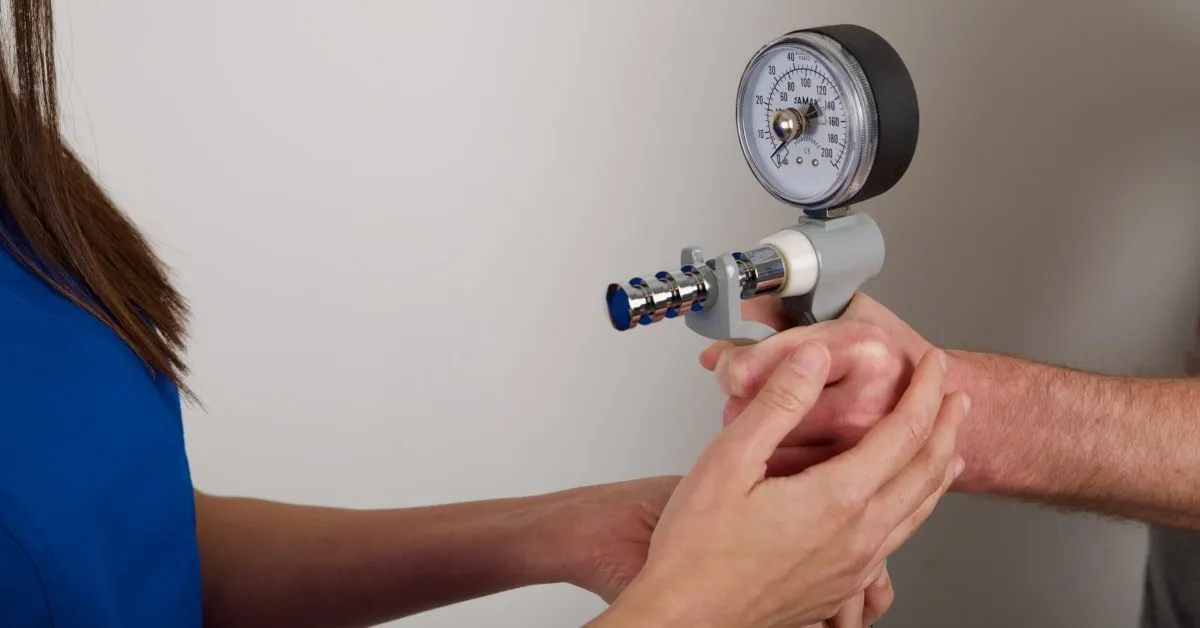
Hand Therapy is a clinical specialism practised by Occupational Therapists and Physiotherapists who focus exclusively on conditions of the hand, wrist, elbow and shoulder. It spans the fields of Plastic Surgery, Orthopaedics, Rheumatology and Neurology. Hand Therapy differs from general MSK Physiotherapy through longer appointments, use of specialist diagnostic equipment, custom splinting and condition-specific treatment guidelines. This guide explains who practises Hand Therapy, how it compares to Physiotherapy and when it might be worth seeing a Hand Therapist.
-
No. Hand Therapy is not the same as general Physiotherapy. Hand Therapy is a clinical specialism for the hand, wrist, elbow and shoulder that goes beyond general MSK Physiotherapy. It offers longer appointments, specialist diagnostic equipment, custom splinting and condition-specific treatment guidelines across Plastic Surgery, Orthopaedics, Rheumatology and Neurology.
-
It can be either and both. Hand Therapy is practised by Occupational Therapists and Physiotherapists who have completed extensive additional training in the upper limb. It is not a separate profession but a clinical specialism within Allied Health.
-
A Hand Therapist assesses, diagnoses and treats conditions affecting the upper limb including clinical assessment, manual therapy, therapeutic exercise, custom splint fabrication, nerve assessment, wound care, scar management, post-surgical rehabilitation and imaging referrals.
-
A Hand Therapist focuses exclusively on the upper limb and will have seen your specific condition many times. This experience is important when your condition specifically affects the hand, wrist, elbow or shoulder. It is also worth considering seeing a Hand Therapist after upper limb surgery, when a condition has not improved with general treatment, a diagnosis is unclear or the injury involves multiple structures such as tendons, nerves and ligaments.
-
In most cases, yes. An initial consultation typically ranges from £80 to £130 in the UK. The higher cost is due to longer appointment times, a higher level of specialism, additional diagnostic equipment and extras such as custom splints. Some private health insurers cover Hand Therapy appointments.
-
In most cases, no. Many private Hand Therapists accept self-referrals directly without a GP letter or surgical referral. Some clinics may wish to see a referral depending on the type of condition.
-
The hand is central to almost every daily task, making it a natural focus for Occupational Therapy. OTs are trained to assess and restore the functional use of the hand for work, self-care and daily living. This functional perspective complements the movement and exercise rehabilitation that Physiotherapists bring to the specialism.
If you have a hand, wrist, elbow or shoulder problem and are trying to decide who to see, you are certainly not alone. Many people start by searching for a Physiotherapist or Hand Physio, which makes sense. Physiotherapy is well known and widely available. Occupational Therapy is less familiar to the general public and its scope is often misunderstood. However, for conditions affecting the hand and upper limb there is a specialism that most people have not heard of until it is needed: Hand Therapy.
What is Hand Therapy?
Hand Therapy is a clinical specialism focused entirely on conditions affecting the hand, wrist, forearm, elbow and shoulder. It covers the full upper quadrant from the fingertips to shoulder joint and is a well-established discipline recognised worldwide. The specialism is supported by a substantial body of ongoing research and is represented by dedicated professional bodies including the British Association of Hand Therapists (BAHT) in the UK, the American Society of Hand Therapists (ASHT) in the United States and the Hand Therapy Certification Commission (HTCC) which awards the internationally recognised Certified Hand Therapist (CHT) credential.
A Hand Therapist assesses and treats hand, wrist and upper limb conditions every working day. This concentrated clinical focus builds a depth of experience with specific conditions that general practice cannot replicate. In much the same way that a Hand Surgeon specialises within Hand and Wrist Surgery, a Hand Therapist specialises within hand to shoulder rehabilitation.
While Hand Therapy covers the hand and the entire upper limb, it can become highly specialised within hospital and trauma settings. Hand Therapists may elect to focus on a specific discipline such as Plastic Surgery, Orthopaedics, Neurology or Rheumatology. This in turn can mean some Hand Therapists specialise in certain parts of the upper limb. For example, those working exclusively in Plastic Surgery services may only work with the hand or forearm but not the wrist, elbow or shoulder.
Is Hand Therapy Occupational Therapy or Physiotherapy?
This is one of the most asked questions about Hand Therapy. The answer is that it can be either and both.
Hand Therapy is practised by both Occupational Therapists (OTs) and Physiotherapists (PTs) who have completed extensive additional training in the upper limb. It is not a separate profession. Hand Therapy is a clinical specialism and often a specific job role within Allied Health Professional (AHP) departments, predominantly in hospital settings and services such as the NHS and private hospitals.
A Hand Therapist’s original professional qualification will be in Occupational Therapy or Physiotherapy, but the specialist training and clinical scope of Hand Therapy is the same regardless of which route they took. Some hospitals separate out the functions between the professions, with Physiotherapists covering some aspects and Occupational Therapists covering others. Other Hand Therapy departments combine the roles, meaning OTs and PTs perform the same functions for the most part.
In practice, the Occupational Therapy and Physiotherapy approaches complement each other within Hand Therapy. Occupational Therapists bring a particular focus on functional independence, daily living, adaptation and return to meaningful activity. Physiotherapists focus on movement, manual therapy and exercise-based rehabilitation. An experienced Hand Therapist will draw from both professions equally. Those who have trained and worked across both disciplines will have a particularly broad clinical perspective. In Northern Ireland especially, this cross-discipline experience is uncommon in both public and private practice, with Occupational Therapists and Physiotherapists typically working as distinct and separate professions.
How does Hand Therapy differ from general Physiotherapy?
A general MSK Physiotherapist treats conditions across the whole body. Back pain, knee injuries, hip replacements, ankle sprains, neck problems and upper limb conditions may all be seen in the same clinic on the same day. This breadth is extremely valuable. However, it can mean any individual area of the body receives a smaller share of the clinician’s experience and focus. Many Physiotherapists also choose to specialise in other parts of the body such as the knee or back.
A Hand Therapist works exclusively with the upper limb. The differences that follow from this are practical rather than theoretical. The table below summarises the key differences between Hand Therapy and general MSK Physiotherapy.
| Hand Therapy | General MSK Physiotherapy | |
|---|---|---|
| Initial appointment | 45 to 60 minutes | 30 to 45 minutes |
| Clinical focus | Upper limb exclusively | Full body |
| Diagnostic equipment | Specialist upper limb tools (goniometers, monofilaments, dynamometers) | General MSK equipment |
| Custom splinting | Custom thermoplastic orthoses fabricated and moulded to patient in clinic | Off-the-shelf supports or referred out |
| Treatment guidelines | Condition-specific upper limb guidelines | Broad MSK protocols |
| Scar and wound management | Specialist techniques integral to practice | Not typically included |
Assessment depth
An initial Hand Therapy appointment will be between 45 and 60 minutes, depending on the service, clinic and setting. This is longer than the 30 to 45 minutes typical of a general MSK Physiotherapy session. The additional time allows for a detailed clinical history, specific upper limb testing including grip and pinch strength measurements, sensation assessment, range of movement measurement at each joint and functional evaluation.
Diagnostic equipment
A Hand Therapy clinic or service will have access to diagnostic tools that general Physiotherapy clinics usually will not carry. Finger goniometers calibrated for small joints, Semmes-Weinstein monofilaments for nerve testing, dynamometers and pinch gauges for strength measurement and standardised exams for assessing fine-motor dexterity. These devices allow for precise measurement and objective tracking of progress over time.
Custom splinting
Hand Therapists fabricate thermoplastic splints in the clinic, moulded directly to the patient. A general Physiotherapy clinic will typically refer out for splinting or use off-the-shelf supports. Custom orthoses can be adjusted as recovery progresses and are designed specifically for the condition being treated.
Specialist treatment guidelines
Conditions like flexor tendon repairs, TFCC injuries, complex fractures and nerve injuries require highly specific rehabilitation guidelines where the timing and progression of exercises is critical. These guidelines are a core part of Hand Therapy training and daily practice. A general Physiotherapist may only encounter these conditions occasionally.
Advanced scar management and wound care are integral to Hand Therapy, particularly following surgery or trauma. Techniques include scar massage, silicone products, compression therapy and desensitisation. This level of specialist wound and scar management is not typically part of general MSK Physiotherapy.
What does a Hand Therapist do?
A Hand Therapist assesses, diagnoses and treats conditions affecting the upper limb. The scope is broad and depends on the individual therapist’s experience and job role. Treatment is typically hands-on from the first appointment. The goal is always to reduce symptoms, restore function and help the patient return to the activities that matter to them.
When might a Hand Therapist be a better fit than a general Physiotherapist?
Many MSK Physiotherapists treat upper limb conditions competently and for straightforward presentations a general Physiotherapist may be all you need. Where a Hand Therapist can add value is in situations where the condition is complex, the diagnosis is unclear or where specialist equipment and guidelines make a meaningful difference to the outcome. Seeing a specialist from the outset can sometimes avoid a longer and more costly path through multiple generalist appointments.
A Hand Therapist is worth considering when:
- You have had surgery on any part of the upper limb. Particularly tendon repairs, nerve repairs or complex fractures where rehabilitation guidelines are time-critical
- Your condition has not improved with general Physiotherapy and you want a specialist opinion
- You have a hand, wrist or elbow condition involving the ligaments, tendons or nerves where detailed assessment changes the treatment approach
- You do not yet have a clear diagnosis and want a specialist assessment to identify what is actually causing the problem
- You have been diagnosed with a condition such as carpal tunnel syndrome, trigger finger, a TFCC injury, a ligament or tendon injury where specialist experience is an advantage
- You need custom splinting as part of your treatment
- Your injury resulted from trauma and involves multiple structures
If you have general back, hip or knee problems alongside an upper limb condition, you may benefit from seeing both a general Physiotherapist for the former and a Hand Therapist for the latter.
Ms Razo is a Certified Hand Therapist (CHT) and Registered Occupational Therapist with clinical experience spanning plastic surgery, orthopaedics, neurology and rheumatology. Initial consultations are 60 minutes and cost £86. Book an appointment online or call +44 (0)28 9099 3464.
Does Hand Therapy cost more than general or MSK Physiotherapy?
In most cases, yes. An initial consultation will typically range from £80 to £130, with London prices closer to £160. The cost depends on location, clinic and setting. The higher cost relative to general Physiotherapy is due to longer appointment times, a higher level of specialism, additional diagnostic equipment and extras such as custom splints.
Some private health insurance providers cover Hand Therapy appointments under their own treatment codes. Other insurers will cover Hand Therapy through Physiotherapy. Because Hand Therapy is practised by both Occupational Therapists and Physiotherapists, it is best to check with your therapist or Hand Therapy clinic and insurer whether your treatment will be covered. There may be an excess on the policy and sometimes insurance will not cover the full cost.
Will I need a referral to see a private Hand Therapist?
In most cases, no. It will depend on the Hand Therapist as well as the clinic or private hospital, but you can often self-refer directly without a GP letter or surgical referral. Some Hand Therapists and clinics focus on particular types of conditions or post-surgical rehabilitation and may wish to see a referral to confirm appropriateness.
Most private Hand Therapists accept self-referrals. If you have existing imaging, referral letters or surgical notes, bring them along to your first appointment.
Can Hand Therapists treat elbow and shoulder problems?
Yes, but this does not mean all Hand Therapists automatically will or have the required experience. As a specialism, Hand Therapy covers the entire upper limb from fingertips to shoulder. Conditions treated can include frozen shoulder, rotator cuff injuries, tennis elbow, cubital tunnel syndrome, elbow fractures, shoulder dislocations and many more. The term “Hand Therapy” is the established name for the discipline but the scope of practice extends well beyond the hand itself. It is important to check whether your Hand Therapist has experience treating the elbow or shoulder as well as the specific conditions relevant to you.
What is a Certified Hand Therapist?
A Certified Hand Therapist is a Hand Therapist who has attained the Certified Hand Therapist (CHT) credential. The CHT accreditation is the internationally recognised credential and benchmark for excellence in Hand Therapy and upper limb rehabilitation. It is awarded by the Hand Therapy Certification Commission (HTCC) following a minimum of 4,000 hours of Hand Therapy clinical practice and a rigorous independent examination must be passed. The credential must be renewed every five years. There are relatively few Certified Hand Therapists practising in the UK. Ms Michelle Razo CHT is the first and only Certified Hand Therapist based in Belfast. Read our full guide on what a Certified Hand Therapist is and why it matters.
Summary
Hand Therapy is a clinical specialism practised by Occupational Therapists and Physiotherapists who focus exclusively on the upper limb. It offers a level of specialist assessment, equipment and clinical experience that general Physiotherapy cannot match for hand, wrist, elbow and shoulder conditions. Whether you have been referred by a Consultant, recommended by your GP or are looking for a specialist after previous treatment has not worked, Hand Therapy is designed for exactly this situation.
Hand Therapy at The Hand Therapist, Belfast
Ms Michelle Razo is a Registered Occupational Therapist, Certified Hand Therapist (CHT) and the Clinical Lead at The Hand Therapist in Belfast. She is Belfast’s first and only CHT, with clinical experience spanning plastic surgery, orthopaedics, neurology and rheumatology across NHS and international settings. Her approach combines the OT focus on function and independence with the hands-on manual therapy and exercise rehabilitation traditionally associated with physiotherapy.
Initial consultations at The Hand Therapist are 60 minutes and cost £86. Follow-up appointments are 45 minutes at £66. These fees are competitively priced alongside general MSK physiotherapy in Belfast while offering a longer appointment, specialist diagnostic equipment, custom splinting and the depth of experience that comes with an exclusively upper limb practice. No GP referral is needed. Ms Razo is a registered provider with BUPA and H3.
If you have a hand, wrist, elbow or shoulder condition and would like to see a specialist, you can book an appointment online or contact the clinic on +44 (0)28 9099 3464.