Tendon Specialist, Belfast
Trigger Finger
Treatment
A finger or thumb that catches, clicks or locks when you try to straighten it.
- Pain at the base of the finger or thumb
- Morning stiffness that loosens during the day
- A nodule or lump in the palm
- Having to use your other hand to straighten the digit
Trigger finger is a progressive condition. Many cases respond well to specialist Hand Therapy when treated early.
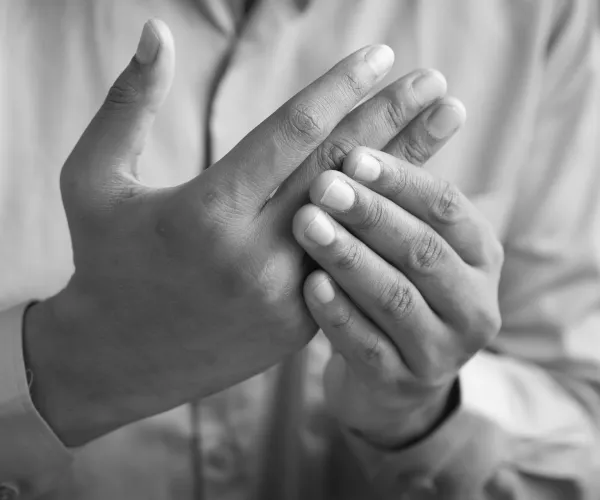
Trigger finger and trigger thumb can often be treated without surgery or injections when managed by a specialist.
Hand Therapy
for Trigger Finger
- Specialist diagnosis of your Trigger Finger or Thumb
- Grading of your Trigger Finger or Thumb
- Custom Trigger Finger Splint
- Guided Trigger Finger Exercises
- Activity modification and education
- Ultra Sounded Guided Injection and Surgical referral for stubborn cases
Ms Razo is a Consultant Hand Therapist and Certified Hand Therapist (CHT) providing specialist non-operative treatment for trigger finger and trigger thumb in Belfast across all grades of severity.
The CHT is the highest internationally recognised credential in Hand Therapy, requiring a minimum of 4,000 hours of specialist clinical practice and a rigorous independent examination.
This depth of experience means your condition is assessed and graded by a clinician who has treated trigger finger many times before.
No referral needed.
Self-refer directly to Ms Razo.
Registered provider with BUPA and H3
Book a ConsultationOr call +44 (0)28 9099 3464
Not based in Northern Ireland? Virtual appointments available UK-wide.
Ms Razo provides specialist trigger finger assessment, grading and rehabilitation via secure video consultation. The same clinical expertise, without the travel.
Understanding trigger finger and trigger thumb
Trigger finger and trigger thumb, medically known as stenosing tenosynovitis, occur when a pulley at the base of the digit becomes thickened and inflamed, causing the tendon to catch or lock as it passes through. It is one of the most common hand conditions, most frequently affecting adults between the ages of 40 and 60 and more common in women.
Triggering is most common in the ring finger or thumb. The condition is graded from 1 to 4 based on severity. Common contributing factors include repetitive gripping, diabetes, rheumatoid arthritis and hypothyroidism. Left untreated, triggering tends to progress. The digit can become permanently fixed in a bent position, making everyday tasks difficult and often requiring surgical intervention that could have been avoided with earlier specialist treatment.
Common signs and symptoms
- A catching, clicking or locking sensation when bending or straightening the finger or thumb
- Pain at the base of the finger or thumb in the palm, particularly on gripping
- A tender nodule palpable at the base of the affected finger or thumb in the palm
- Morning stiffness: the finger may be more locked in the morning and loosen during the day
- In severe cases, the digit becomes fixed in a bent position and cannot be straightened
- Catching or clicking that is becoming more frequent
- A finger or thumb that locks and needs the other hand to straighten
- Pain at the base of the digit that is not improving
- Symptoms affecting your grip, work or daily activities
Early specialist assessment leads to better outcomes. Book a consultation
What patients say
"Michelle was able to provide a diagnosis of trigger finger, issues with my ulnar/median nerves and forearm muscles. I wasn't able to get this diagnosis elsewhere and Michelle made me very confident that I would be able to return to my sport without the need for steroid injections."
Caitriona D · Trigger finger & nerve issues
"Thanks to the wonderful work done by Michelle I am now pain free and avoided going down the injection/surgery route. For anyone hoping to avoid injections/surgery I highly recommend her. She is AMAZING!"
Kim M · RSI & de Quervain's
"I was very impressed with my consultations with Michelle. Not only was the treatment thorough but was delivered in a caring, empathetic and friendly manner. I appreciated the advice regarding the surgical procedure too."
Vivien K · Trigger thumb
Frequently asked questions
-
No. You can self-refer directly. No GP letter or consultant referral is needed. If you have existing imaging or referral letters, it is helpful to bring them along to your first appointment.
-
An initial consultation with Ms Razo is £86 for 60 minutes. Follow-up sessions are £66 for 45 minutes. If a custom splint is required, prices start from £15 depending on the type and size. Ms Razo is a registered provider with BUPA and H3.
-
Yes. Ms Razo provides specialist trigger finger assessment and management via virtual appointments for patients who cannot attend in person. Grading, splint guidance, exercise prescription and ongoing rehabilitation can all be delivered remotely. Find out more about virtual Hand Therapy appointments.
-
This depends on the grade of triggering and how early treatment begins. Many patients with Grade 1 or 2 triggering see a significant reduction in symptoms over a prescribed period of consistent splinting and activity modification. Ms Razo will give you a realistic assessment at your first appointment.
-
Mild triggering can occasionally settle with rest and activity modification alone. However, without treatment it often persists or progresses. Splinting and Hand Therapy are effective non-operative management options.
-
No. Many cases of triggering respond well to non-operative management including splinting, activity modification and Hand Therapy. Surgery is typically reserved for cases where conservative measures have not been successful, or for fixed triggering that cannot be passively corrected.
-
No. Trigger finger is a tendon condition, not a joint condition. It occurs when the A1 pulley at the base of the digit becomes thickened and inflamed, restricting tendon gliding. However, triggering is more common in people with rheumatoid arthritis and other inflammatory conditions.
-
Recurrence after Hand Therapy or corticosteroid injection is possible, particularly in patients with diabetes or multiple affected fingers. Recurrence after surgical A1 pulley release is uncommon. Ms Razo will advise on reducing the risk of recurrence.
-
A1 pulley release is a minor surgical procedure in which the fibrous band at the base of the finger or thumb is divided to widen the tunnel through which the flexor tendon runs. This resolves the mechanical obstruction causing triggering. Ms Razo provides post-operative Hand Therapy following this procedure. Find out more about specialist rehabilitation after surgery.
Other hand conditions
Clinically reviewed by Ms Michelle Razo CHT · April 2026
Ready to take
the first step?
Book a consultation with Ms Razo and receive a thorough assessment, precise diagnosis and a personal treatment plan.